A Quiet Table for Sharing Keepsakes on a Rainy Afternoon
A keepsake-sharing afternoon can feel gentle, not performative: choose a format, set simple boundaries, and make room for stories and silence alike.
The common mistake with a keepsake-sharing afternoon is asking everyone to explain an object as soon as it reaches the table. That turns a gentle gathering into a round of public speaking, and a person who brought something private may feel exposed. A quieter plan lets each guest decide whether to talk, listen, or simply keep a hand near a familiar thing.
A keepsake-sharing afternoon works best when the object is an invitation, not an assignment. You might ask relatives or friends to bring one small item that matters to them, then choose a format that fits the people coming. A rainy afternoon helps by giving everyone a reason to stay in, but the useful part is the pace: there is time to notice, pause, and listen without rushing to the next person.
What should the invitation promise?
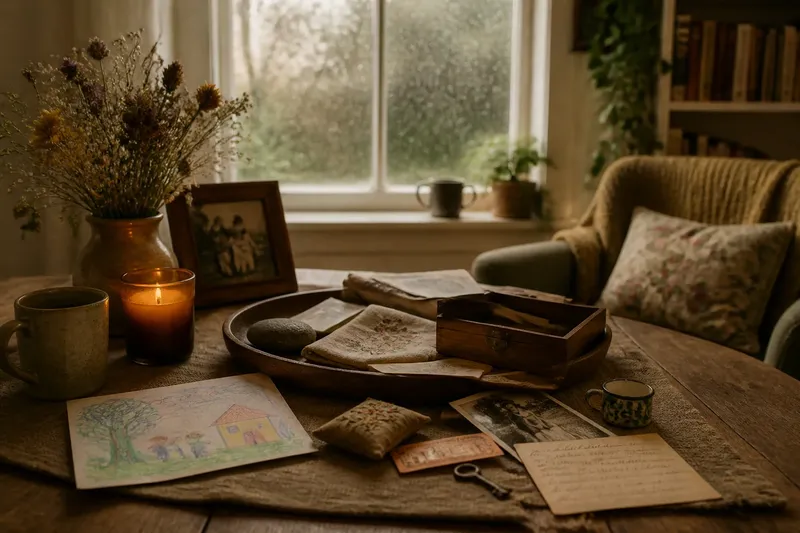
Be specific enough that guests know what to expect, but leave the meaning of “keepsake” open. A recipe card, a smooth stone, a child’s drawing, a ticket stub, or a useful household object can carry a story. The object need not be old, valuable, or connected to a dramatic event.
Make the choice to speak optional in the invitation itself. For example: “Bring one object you’re comfortable setting on the table. You can tell its story, say a little about it, or pass and listen.” That sentence gives people permission to come without preparing a performance.
Offer a few practical boundaries, too. Ask guests to bring something small enough to place safely on the table, and to leave fragile or irreplaceable items at home if handling them would feel stressful. Tell everyone whether photographs or recordings are planned; the simplest default is no recording unless each person involved agrees. If a guest wants to share a story that includes someone else, they can keep private details out of the telling.
Which format fits your group?
There is no need to make every gathering follow the same pattern. Choose among a loose open table, a gentle speaking circle, or paired conversations. Each gives people a different amount of structure and attention.
When does an open table work best?
Set the objects in one place and let guests look at them at their own pace. People can ask a question, offer a brief comment, or sit nearby without presenting anything. This suits a mixed group, a drop-in gathering, or anyone who might prefer to speak only when a natural conversation begins.
The trade-off is that the room may split into smaller conversations, and one person’s story can be harder for everyone to hear. Keep the table uncluttered, leave space around each object, and invite guests not to pick things up without asking. A small card beside an object can carry its owner’s name or a note such as “please ask before handling,” without demanding a written story.
Would a speaking circle feel comfortable?
Place chairs in a loose circle and invite each person to share if they wish. The group can listen without interrupting, then ask one gentle question after the speaker finishes. This format suits a close-knit group that enjoys hearing everyone in turn and gives quieter voices a protected opening.
It can feel formal if the group is large or unfamiliar, so avoid a strict order or a required speech. A simple “pass for now” is enough. No one needs to explain why they pass, and a person who has already shared can choose to listen for the rest of the gathering.
When are paired conversations a better choice?
Invite guests to sit in pairs, with each person taking a turn to show an object and talk, or to listen. Afterward, people can share only what they want with the wider group. This suits guests who find a large audience daunting or who would rather have a quieter exchange.
Pairs make it easier to follow a story closely, though the room may become lively with overlapping voices. Offer a quiet corner or a spot near a window for anyone who wants a break. If someone prefers not to pair off, they can stay at the table, join a conversation later, or simply enjoy the gathering.
How can you make room for listening?
Give the afternoon a loose rhythm rather than a packed schedule. Welcome people, let them settle with a drink, and allow a little time to place objects on the table. Once everyone has arrived, explain the options in a few plain sentences. Then follow the group’s energy instead of moving through a list on the clock.
Good listening is not the same as asking for more detail. A story may touch on grief, a family disagreement, or a memory someone does not want to unpack. Let the speaker set the limit. A small response such as “Thank you for sharing that” can be more considerate than a string of questions.
- Ask before picking up or passing around an object.
- Let people finish before responding.
- Do not correct someone’s memory in front of the group.
- Accept “I’d rather not say” or a change of subject without pressing.
- Leave pauses alone; silence can be part of listening.
Think of the table like a shared windowsill: each person may set something down, look at what others brought, and decide what to take back into conversation. No one has to open every drawer behind an object. That distinction keeps curiosity warm rather than intrusive.
How should you handle keepsakes and stories?
Ask each owner how they want their object treated. Some may be happy for others to hold it; others may prefer to keep it in their own hands. Arrange cups and food away from the objects, and avoid placing anything where a sleeve, bag, or crowded chair could knock it over. If an item is delicate, its owner can describe it without passing it around.
Do not assume that the story belongs to everyone just because the object is visible. Guests can share a small detail without giving the full history, and they can change their minds about what is repeated afterward. If you would like to keep a note of a story, ask permission first and agree on what may be shared and with whom. Follow any care instructions that come with an object, and use common sense around fragile or personally sensitive items.
Say you invite a cousin who brings a folded recipe card but does not want to read it aloud. You can ask whether they would like to point out one familiar mark, sit with the card privately, or pass for now. The observable result is a choice the cousin controls; the gathering does not depend on extracting the recipe’s history.
What questions help without putting anyone on the spot?
Keep a few invitations in mind, but do not use them like prompts in an interview. Ask one, then let the answer determine whether another belongs. These questions are useful because they leave room for a short answer or none at all.
Can someone bring an object without sharing its story?
Yes. Bringing an object is enough participation, and a guest can pass, listen, or speak later if they choose. Make that option clear before the gathering begins.
What if someone forgets to bring a keepsake?
Let them join without one, or invite them to choose an ordinary object already in the room if they want. The gathering is for being together, not checking who completed an assignment.
Should the host ask what an object means?
Ask gently and accept a brief answer or no answer. “Would you like to tell us anything about it?” gives the owner more control than “What happened?”
Can a guest take a story home to share?
Ask the storyteller before repeating it, especially if it includes personal details or another person. A story told in a small gathering is not automatically permission to circulate it.
How do you choose the right approach?
Choose the open table when people may arrive at different times, when the group is large, or when casual conversation feels safer than a turn-taking format. Choose a circle when guests know one another and would appreciate a shared listening space. Choose pairs when a large audience could make speaking difficult or when quieter conversation is the point.
You can combine formats without turning the afternoon into a program. Begin with an open table, then offer a circle for anyone who wants to share; let others remain where they are. Or start with pairs and bring the group together only if people seem ready. Keep the invitation and the actual gathering aligned: if you promised an optional, unhurried afternoon, do not end by calling on everyone in turn.
Close with a simple signal that the gathering is winding down, such as bringing out tea or inviting people to collect their belongings. Let each owner take their object home, and thank guests for listening as well as speaking. A keepsake-sharing afternoon can leave behind no formal record at all; its value may be the feeling that a person’s choice, silence, and story were all welcome at the same table.