Voice Memo or Written Page: Two Ways to Keep a Recollection
Voice memo or written page: compare what each preserves, choose a comfortable way to capture a family memory, and make it easier for relatives to revisit.
The common mistake with a voice memo or written page is choosing the format that feels easiest for the recorder, then asking the storyteller to adapt. That can cost you the details that give a recollection its shape: a pause before a name, an unexpected turn in the conversation, or the teller’s own phrasing. Choose by asking what the storyteller wants to make possible for the next person who encounters the memory.
What should a relative be able to do with the memory?
A voice memo lets someone hear a person tell a story in their own rhythm. A written page lets a reader scan, return to a passage, and follow names or events without replaying a conversation. Before recording or writing, decide what the family is trying to preserve: a voice, a scene, a recipe’s spoken instructions, a message for a relative, or a story that people can easily find and share.
That purpose can matter more than the subject. A memory about a family gathering might depend on a familiar toast or the sound of everyone laughing; audio can carry those qualities. If the recollection involves a complicated set of relationships, a page may help readers keep track of who did what. Think of the formats as different household containers: a jar and an envelope can both hold something precious, but each makes a different kind of handling easy.
How do you choose between a voice memo and a written page?
Ask the storyteller what feels comfortable, then match the format to the job. A person who enjoys talking may find a phone recording natural; someone who prefers to pause and revise may want a notebook or a basic document. Someone who dislikes hearing their recorded voice might dictate to a trusted relative, while a person who struggles with typing may find conversation easier.
- If the memory depends on a voice, check whether the teller wants to preserve a phrase, laugh, song, or exchange. If yes, record audio; if no, use a page or let the storyteller choose.
- If several people need to be identified, check whether names and relationships are clear in the telling. If they are hard to follow, make a written account with names or a short accompanying note; if they are already clear, audio may be enough.
- If the teller needs time to reflect, check whether they want to stop and revise. If yes, offer a notebook or document they can revisit; if no, offer a relaxed conversation and record only with their agreement.
- If typing is difficult, check whether speaking feels easier for the storyteller. If yes, use a voice memo or a conversation with a trusted note-taker; if no, offer handwriting or another accessible way to communicate.
- If the memory includes a group conversation, check that everyone is comfortable being recorded. If yes, audio can preserve the exchange; if anyone would rather not be recorded, take notes or capture only the willing participants’ contributions with clear agreement.
- If a future reader needs to find the account quickly, check whether the family can search or recognize the chosen file. If not, add a plain title and a brief description or use a written page; if yes, keep the format the storyteller prefers.
These are decision points, not fixed rules. Ask which details the storyteller most wants a future relative to hear, see, or understand. The answer can guide the format even when the subject could work either way.
How can you make recording feel like conversation?
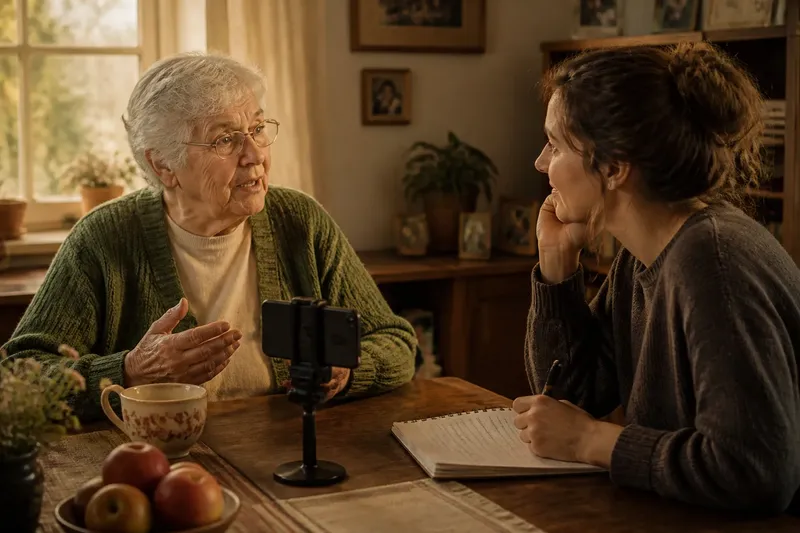
A phone aimed at someone can turn a relaxed chat into a performance. Instead of asking for a polished story from beginning to end, set the phone on a table, make sure the microphone is not covered, and ask one open question. Let silence sit for a moment; a pause may mean the person is thinking, not that the conversation has failed.
Say you want to preserve an aunt’s memory of learning to bake with her older sister. She goes quiet when asked to tell the whole story. You set the phone nearby and ask what the kitchen smelled like, then what her sister said when the dough went wrong. The expected result is a smaller scene with sensory detail and remembered dialogue, rather than a pressured attempt to cover an entire life story.
If the teller would rather not be recorded, put the phone away. You can ask permission to take notes, or invite them to write or dictate later. The person’s comfort sets the boundary; the story does not need to be captured in one sitting.
How can a written page keep the teller’s voice?
Editing can make a recollection easier to follow, but too much polishing can make it sound unlike the person. Keep natural expressions and characteristic turns of phrase when their meaning is clear. If a reader would not know who “she” refers to, add a brief clarification rather than rewriting the whole passage in a formal voice.
Offer choices that fit the storyteller: a notebook, a basic document, a letter addressed to a family member, or fragments that can be shaped later. Keep the original wording in a separate copy before making substantial edits. That leaves room to clarify the account without confusing the teller’s words with an editor’s additions.
A side story may explain a nickname or why a place mattered. If it makes the sequence hard to follow, add a transition or a short note. Do not remove it just because it is not part of a neat beginning-to-end narrative.
What helps relatives use the recording or page later?
A recording can be clear in the moment and puzzling later. People may say “over there” or use a family nickname that only makes sense in the room. Before you finish, ask for unclear names to be repeated, and make a short note identifying the subject and the people mentioned. A title such as “Aunt Lena remembers the bakery” is more useful than “Audio 4.”
For a written page, add a brief orientation near the start: who is telling the story, who the central people are, and the general setting. If a name is uncertain, mark it as uncertain instead of choosing one silently. Break the text when the story shifts to a different scene, and make clear when a sentence is an editor’s clarification.
For either format, agree on who may keep or share the material. If other relatives appear or speak in it, ask them before recording or passing it along. Store the file or page somewhere the people involved can access, using a method they know how to manage.
What should you do when a story becomes difficult to capture?
What if the storyteller jumps between events?
Let the person finish the first telling, then ask which moment they most want a relative to understand. A written account can arrange scenes afterward; audio can retain the original path, with a short note pointing to the central moment.
What if the storyteller cannot recall a name?
Do not press them to guess. Leave a clear note that the name is uncertain, and let a relative add a correction later if they have a sound basis for it.
What if several relatives speak at once?
Pause and invite people to take turns if everyone is comfortable continuing. In audio, say each speaker’s name when it is not obvious; in writing, identify speakers so readers can follow the exchange.
What if the storyteller wants to stop?
Stop and save what they have chosen to share. Ask whether they want to resume another time, continue on a page, or leave the account as it is.
When is it useful to keep both formats?
Keeping both can make sense when each has a distinct purpose: audio preserves the original telling, while a short written note helps relatives recognize and locate it. A full transcript is not necessary for every memo. A clear title, a few names, and a brief description may be enough to make a recording easier to revisit.
Imagine your uncle wants to preserve a story about repairing a radio with his mother, but he dislikes typing. He agrees to a voice memo, and you ask him to name the people and place at the start. Afterward, you write a short note titled “Uncle Ray and the kitchen radio,” list the names he mentioned, and save the note beside the recording. The audio keeps his telling; the note gives relatives a quick way to identify it. If he had preferred not to be recorded, the tradeoff would be a written account in his own words, with less of his spoken delivery preserved.
For a voice memo or written page, choose the form that lets this storyteller share the details they care about without turning the memory into a performance. A clear purpose, a comfortable method, and a useful title can help relatives return to the account and recognize whose voice or words they are reading.